Why We Built HabitGrip After Failing with 7 Other Apps
After one year and seven habit tracker apps, none of them stuck. Here is the story of what kept failing — and why we built HabitGrip.
One year. Seven habit tracker apps. An embarrassing number of “perfect” routines that lasted nine days.
None of us failed because we do not care about consistency. We failed because every tool we tried was designed for a person who does not exist — someone with unlimited willpower, a fixed schedule, and no bad days. When real life showed up, the app was not on our side. It was keeping score.
This is the story of what kept going wrong — and why we eventually stopped looking for another tracker and built one ourselves.
The seven apps we abandoned
We are not naming names — the point is not to mock any specific app. Each one taught one of us something, and together they made the pattern impossible to ignore:
| App | The promise | Why it didn't stick |
|---|---|---|
| 1. The minimal grid | “Just check the boxes.” | No reminders, so I kept forgetting. |
| 2. The gamified one | XP, levels, and badges. | Once the streak was gone, so was the motivation. |
| 3. The social one | Accountability with friends. | A missed day became public. I stopped opening it. |
| 4. The habit-science one | “Backed by research.” | Setting up one habit took fifteen minutes and a flow chart. |
| 5. The subscription suite | Everything, synced everywhere. | My history lived behind a paywall on someone's server. |
| 6. The calendar-adjacent | Time-block my whole day. | Punishing the moment my schedule varied. |
| 7. The “perfect” one | Fifty features for everything. | I spent more time configuring than doing. |
Look at the last column and a pattern emerges. It was never about whether the app could record a checkmark. It was about what happened the morning after a missed day.
What they all got wrong
Strip away the different skins and the seven apps shared three assumptions. Every one of those assumptions was wrong for us — and we suspect for a lot of other people too.
1. Streaks turned consistency into shame
The day I missed, the streak died, and the app punished me for it. Some apps even send a sad-faced notification about it. A system that makes a missed day feel like a moral failure is not a system — it is a guilt machine. And guilt is exhausting. After the third broken streak in a row, most people quietly delete the app rather than face the emptiness of the counter. If this sounds familiar, we have written about tracking habits without obsessing over streaks.
2. The schedule assumed a perfect week
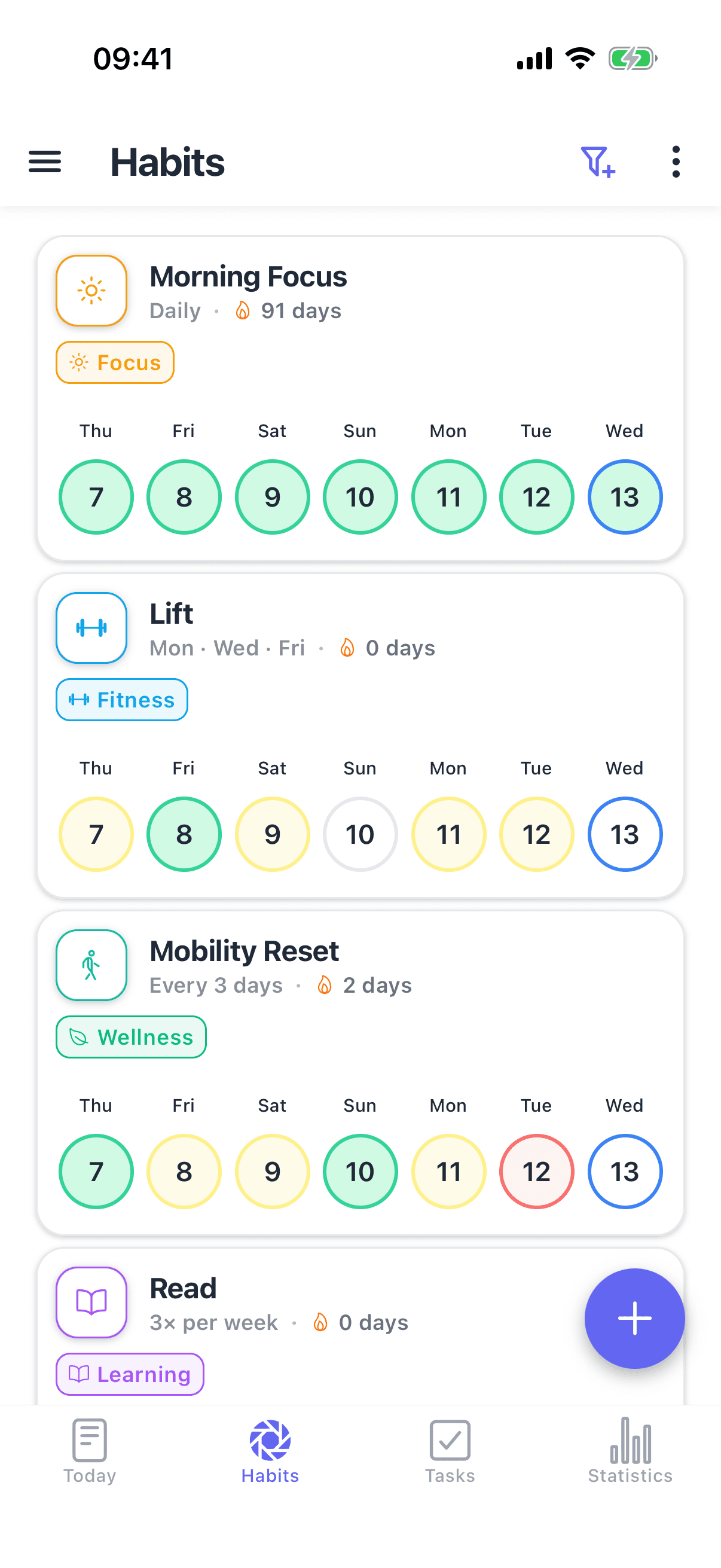
“Daily” is easy for the app to draw and terrible for real life. What about a habit that happens three times a week, on whichever days work? Or every other day for a recovery routine? Most apps force every habit into a rigid grid, so I ended up configuring my life around the app instead of the other way around.
3. My data lived somewhere I did not control
Cloud-first sounds convenient until the trial ends, the subscription lapses, or the app changes hands. Then six years of history is suddenly a “premium feature” or gone entirely. It never felt like my data. It felt like I was renting my own habits from someone who could raise the rent.
So we wrote a different brief
Instead of asking “what should a habit tracker look like,” we asked “what would a tool look like that a tired, busy, real person could still be using a year from now?” Four answers came back — and they became the four rules of HabitGrip.
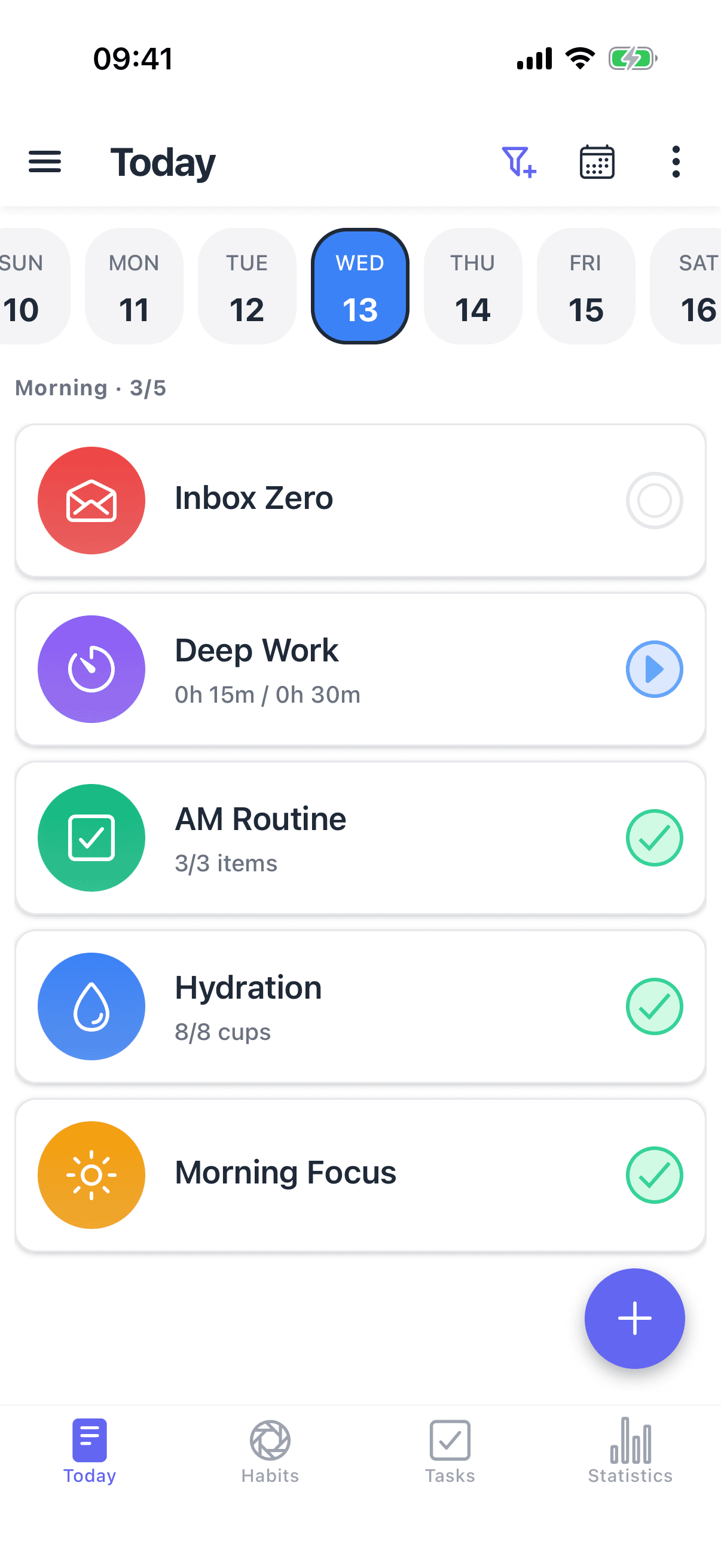
- Local-first, private by default. Your habits live on your device. No account required to start, no server holding a copy of your routine, no ads, no marketing trackers. Sync exists, but it is optional, encrypted in transit, and opt-in.
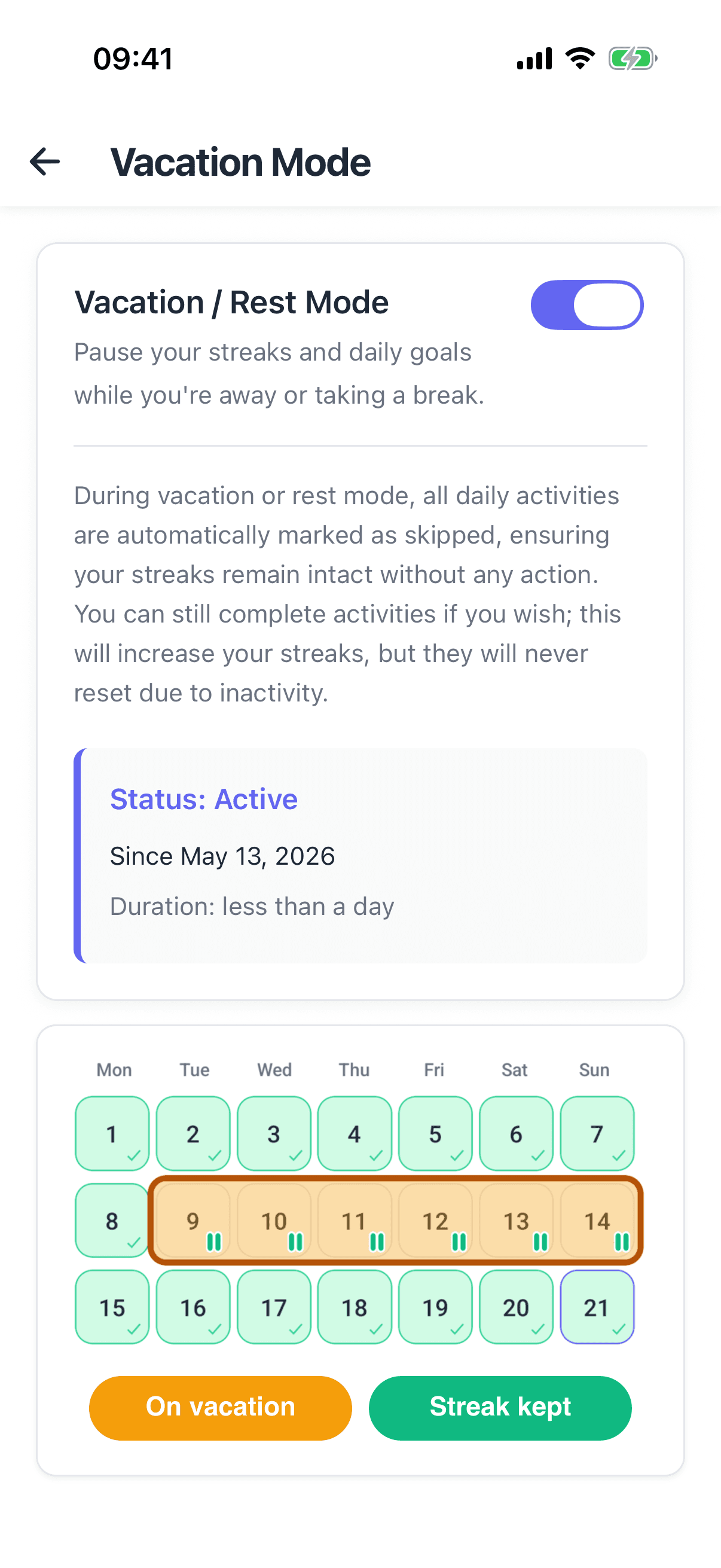
- Honest statuses, not just success or failure. Sometimes you did not do the habit and that is information, not a sin. HabitGrip lets you record the honest picture — and when you need a real break, vacation mode pauses the schedule without guilt.
- Schedules that bend around real life. Daily if you want it. Three times a week if that is the truth. Every other day for recovery habits. The app does the bookkeeping; you just show up.
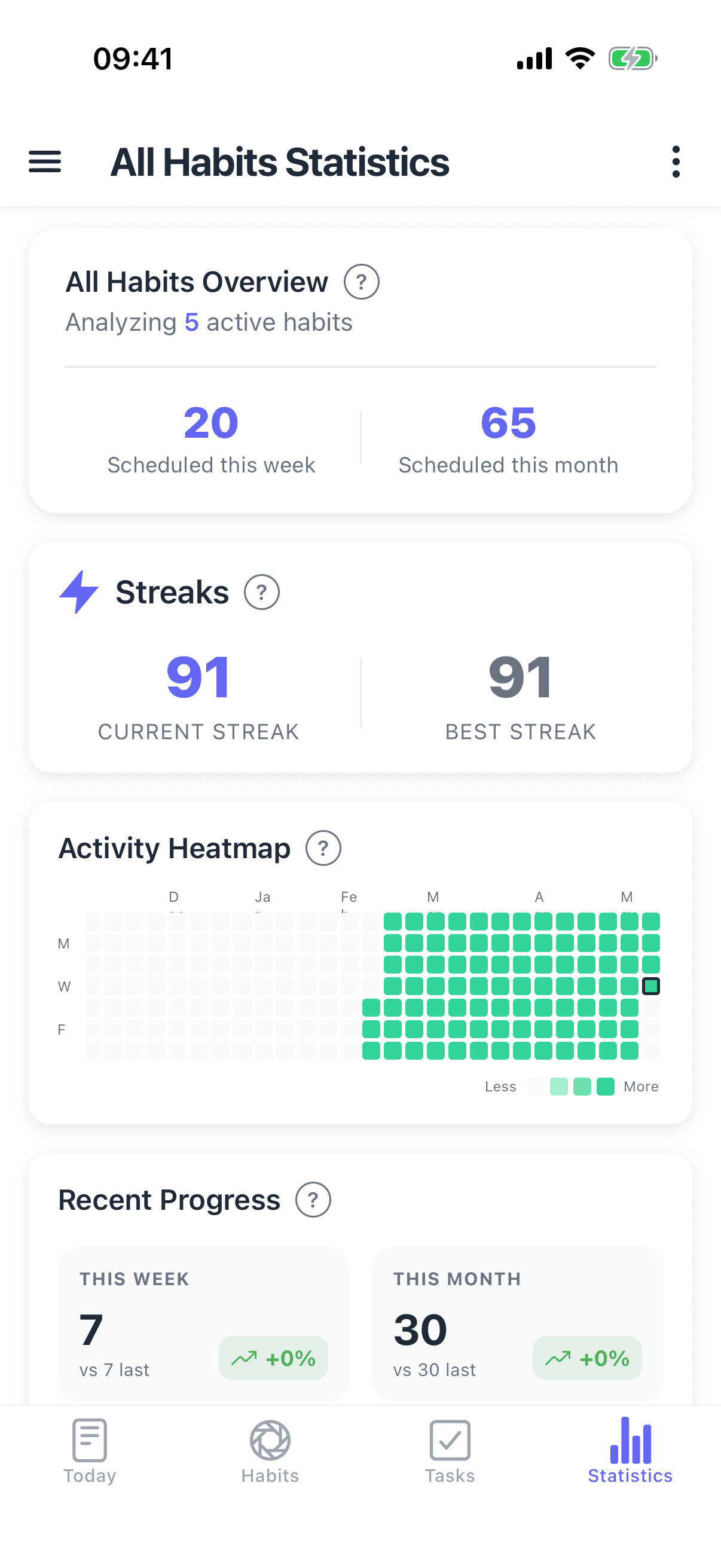
- Calm over gamification. No coins, no levels, no leaderboards. The only reward is an honest heatmap that fills in over the months — which turns out to be far more satisfying than any confetti animation.
The parts that used to break
The proof is not in the manifesto — it is in what happens on the bad days, because those are the days every other app lost us.
When I am sick, I put the affected habits on vacation mode instead of watching a streak die. When a teammate skips a workout, they mark it honestly — Failed — and move on. The heatmap shows a lighter spot, and next week it is filled again. Nothing resets. Nothing nags. The record keeps telling the long story, not the one bad day.
The monthly review became the payoff
Once the guilt was gone, something unexpected happened: I actually wanted to look at the data. The monthly and day-of-week views in the statistics screen showed me that Monday was my weak day, and that my two best habits only worked when they followed my morning coffee. That is not inspiration. That is information — and information is what gets a routine through its 25th day.
What we actually learned
After one year and seven apps, the honest conclusion is that consistency is not a personality trait. You are not “bad at habits.” The tools you tried were mostly designed to sell you a streak, a subscription, or both.
The framework that finally worked was not novel — it is the one in Atomic Habits: design the environment, keep the behavior small, and never miss twice. What was missing in that first year was a tool that let us apply that without punishing the days that were simply hard.
So we built one — quietly, for people who want to show up a thousand times rather than be perfect for nine days. If you have abandoned a tracker before, if the word “streak” makes your stomach drop, or if you want your habit data to belong to you, then you are exactly the person HabitGrip was made for.
Frequently asked questions
Is HabitGrip really built on the failures you describe?
Yes. Every design choice here — local-first storage, honest skip and fail states, vacation mode, flexible schedules, and no gamified rewards — came from a specific frustration with a tool we actually tried and abandoned.
Does HabitGrip have streaks?
Streaks exist, but they are a quiet record of consistency, not a scorekeeper. When a streak is the only measure of success, one missed day feels like failure. HabitGrip keeps history, heatmap, and momentum views so a single day off does not erase your progress.
Do I need an account to use HabitGrip?
No. HabitGrip is local-first: your habits live on your device and you can use it without signing in. An optional account adds cloud sync and automatic backups — and even then, your data is only transmitted when you turn it on.
Can I import the habits I already track elsewhere?
Yes. HabitGrip supports importing from other habit trackers, and you can export your own data as JSON at any time. There is no lock-in — the door swings both ways.
Is HabitGrip free?
HabitGrip is free to start and works fully offline with no ads. An optional paid tier unlocks unlimited habits, tasks, and profiles; Ultra adds cross-device sync and automatic cloud backups.
See if this one sticks
We did not build HabitGrip to win the first nine days. We built it to still be useful on day 900. If you want a tracker that takes your bad days as seriously as your good ones — and keeps your data on your device — here is how to get started.
Build habits, quietly and consistently
HabitGrip is the calm, local-first tracker built from seven failed apps thought about differently. Track habits and tasks offline, skip days honestly, and treat streaks as a quiet record — not a verdict.